
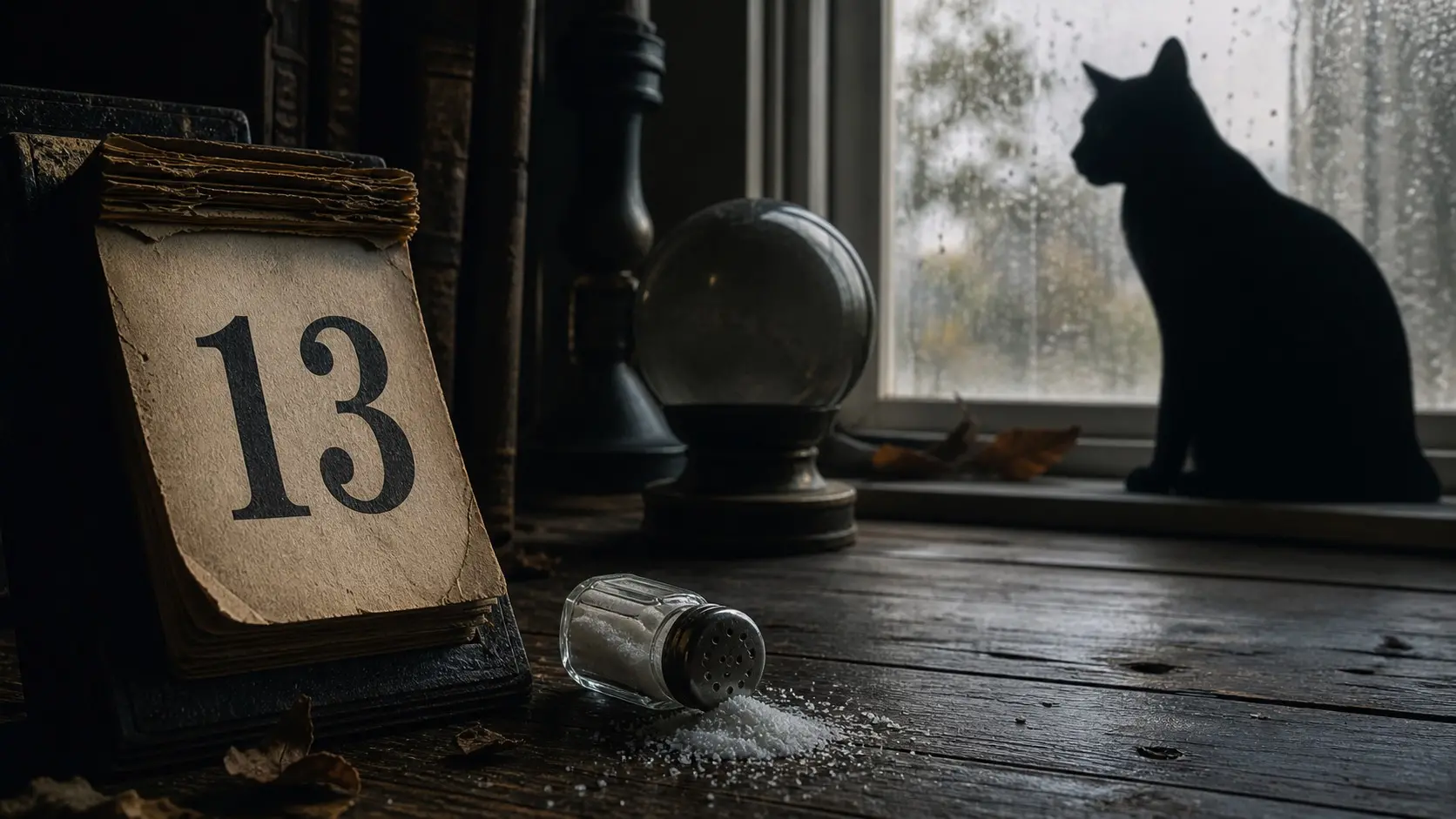
In 1907, a flamboyant stock promoter named Thomas Lawson published a novel that would, perhaps inadvertently, curse the century to follow. Titled *Friday, the Thirteenth*, the book detailed a nefarious broker’s attempt to crash the stock market on that specific date. Before the book’s release, the American public generally viewed the number thirteen with a side-eye and Fridays with a shrug. But Lawson’s narrative tapped into a latent anxiety, weaving two disparate threads of bad luck into a single, cohesive rope. Within weeks of the book’s publication, the phrase had migrated from the page to the ticker tape, and a new brand of collective hysteria was born.
We often think of superstitions as dusty relics—the quaint "knocking on wood" of our grandparents. But Friday the 13th is different. It is a modern, synthesized nightmare that demonstrates how human belief can manifest as a physical, measurable force in the world. It is the day the ghost in the machine becomes the machine itself.
The Math of Misery
To understand why this date became a "nightmare," one must look past the slasher films and into the ledger books. For economists, Friday the 13th isn't about Jason Voorhees; it’s about the "Friday the 13th Effect."
Every time this date rolls around, the global economy takes a perceptible, if irrational, hit. It is estimated that hundreds of millions of dollars are lost in productivity and canceled transactions. People refuse to sign contracts, postpone weddings, and—most significantly—avoid boarding airplanes. In the aviation industry, the nightmare is literal. For decades, some airlines have skipped "Row 13" entirely, an architectural admission that even in an age of jet turbines and GPS, we are still governed by the same fears that haunted the stone circles of the Neolithic.
Consider the case of Elias, a high-frequency trader in London. Elias is a man of logic, a devotee of algorithms and cold, hard data. Yet, on Friday the 13th, Elias feels a subtle shift in the market’s "vibe." He notices that buy orders lag. He sees a slight, statistically significant dip in volume. "It’s a self-fulfilling prophecy," he explains. "I don’t believe in the bad luck, but I believe that *other people* believe in it. And in finance, perception is the only reality that matters."
A Convergence of Ghosts
How did we get here? The nightmare is a cocktail of two very different historical traumas. On one hand, you have the "Hangman’s Day." For centuries, Friday was the traditional day for public executions in Britain, a day associated with the gallows and the finality of the noose. On the other hand, you have the "Unlucky Guest." This reaches back to the Last Supper, where thirteen people sat at the table, and the thirteenth—Judas Iscariot—was the betrayer.
When these two shadows merged, they created a cultural "perfect storm." By the time the Knights Templar were purportedly rounded up and executed on Friday, October 13, 1307 (a historical claim that is debated but culturally cemented), the date had already begun to take on a life of its own.
But the real nightmare isn't historical; it’s neurological. The human brain is a pattern-matching engine. We are hardwired to find meaning in chaos. If you stub your toe on a Tuesday, you blame your shoes. If you stub your toe on Friday the 13th, you blame the universe. This is known as *confirmation bias*. We ignore the millions of things that go right on this day and hyper-focus on the one thing that goes wrong, feeding the monster until it grows large enough to block out the sun.
The Modern Echo
In the late 20th century, the nightmare took on a more literal, visceral form through the lens of pop culture. When Sean S. Cunningham released the first *Friday the 13th* film in 1980, he didn't just create a horror franchise; he gave the superstition a face. Suddenly, the "nightmare" wasn't just a vague feeling of unease or a dip in the Dow Jones—it was a hulking figure in a hockey mask.
This shift moved the fear from the parlor to the subconscious. It turned the date into a "brand" of dread. Today, the nightmare has evolved once more, migrating into the digital realm. Cybersecurity experts often see an uptick in "logic bomb" viruses and malware designed to trigger on Friday the 13th. Hackers, like Thomas Lawson a century ago, use the cultural weight of the day to amplify the psychological impact of their attacks.
Why We Hold On
Why do we continue to entertain this nightmare? Why, in an era of space telescopes and quantum computing, does a specific square on a calendar still make us hesitate?
Perhaps it’s because Friday the 13th provides a rare, collective moment of humility. It is a day when we admit that despite all our technology and all our "rational" systems, we are still deeply, beautifully, and terrifyingly human. We are creatures of story and symbol. We need our monsters, even if we have to invent them ourselves.
The nightmare of Friday the 13th is not that something bad *will* happen. The nightmare is the realization of how much power we give to the shadows. It is a reminder that the world is not just made of atoms and energy, but of the stories we tell each other in the dark. And as long as we keep telling the story of the unlucky thirteen, the nightmare will remain—not as a curse from the heavens, but as a reflection of our own enduring, irrational hearts.
So, the next time the 13th falls on a Friday, pay attention to the silence. Notice the empty seats on the bus, the slight hesitation before a handshake, the way the world seems to hold its breath. It’s not the universe conspiring against you; it’s just eight billion people sharing the same ghost story.
Practical Context for Readers
Cultural practices are easiest to understand when they are viewed as part of a living social setting rather than as a checklist of rules. For anyone encountering Ways Friday the 13th Actually Became a Global Nightmare for the first time, a thoughtful approach begins with observation: notice the setting, follow the pace of local hosts, and ask respectful questions when clarification is welcome. Small details such as timing, tone, dress, table manners, or conversational distance can carry meanings that are not obvious to visitors.
It is also helpful to avoid treating one custom as representative of every person or place. Communities have regional differences, family traditions, and generational preferences. The most useful takeaway is therefore not a rigid formula, but a habit of curiosity and care. When readers arrive prepared to listen, adapt, and respond with good faith, cultural encounters become less intimidating and more rewarding.
How to Apply the Insight Respectfully
Before putting advice into practice, consider the purpose behind the tradition. Is it meant to show hospitality, create connection, mark a celebration, or protect social harmony? Understanding that purpose makes it easier to choose an appropriate response. If you make a mistake, a calm apology and willingness to learn will usually matter far more than perfect performance.
This perspective also applies beyond travel. Teams, classrooms, friendships, and international workplaces all benefit when people recognize that familiar gestures may be interpreted differently elsewhere. By slowing down, checking assumptions, and choosing respect over certainty, readers can turn cultural knowledge into more considerate everyday communication.