
Article
In the late 1940s, as the world stitched itself back together after a global war, a peculiar map began appearing in American classrooms. It wasn’t a map of nations or continents, but of food. Divided into seven colorful wedges—butter, leafy greens, citrus—the “Basic 7” was a labyrinthine guide to nutrition, a patriotic duty to ensure a strong populace. It was well-intentioned, complex, and for most people, utterly forgettable the moment the school bell rang.
For decades, this was our approach to healthy eating: a complex equation of charts, pyramids, and prescriptions that demanded constant vigilance. We became calorie accountants, gram counters, and micronutrient detectives. Eating well felt like a second job, a high-stakes puzzle where failure meant not just an unsatisfying meal, but a slight betrayal of our own biology.
What if we’ve been overthinking it all along? What if the secret to balanced nutrition isn’t found in a textbook, but in a simple, elegant gesture?
This is the quiet genius of the Plate Method—a concept so intuitive it feels less like a diet and more like a rediscovered piece of common sense. It’s a visual philosophy, a rule of thirds for your fork. It asks you to do one thing: look at your empty plate not as a void to be filled, but as a canvas to be composed.
Imagine Elena, a novelist who spends her days wrestling with complex plots and unruly characters. By evening, her decision-making faculties are shot. The thought of calculating her dietary intake is exhausting. For years, she defaulted to simple carbs—a big bowl of pasta, a quick sandwich—because they were easy. But this simplicity came at a cost: energy slumps, brain fog, and a nagging sense of being out of tune with her own body.
Then, a dietician introduced her to the Plate Method. No apps, no scales, no forbidden foods. Just a simple, three-part instruction for her standard dinner plate.
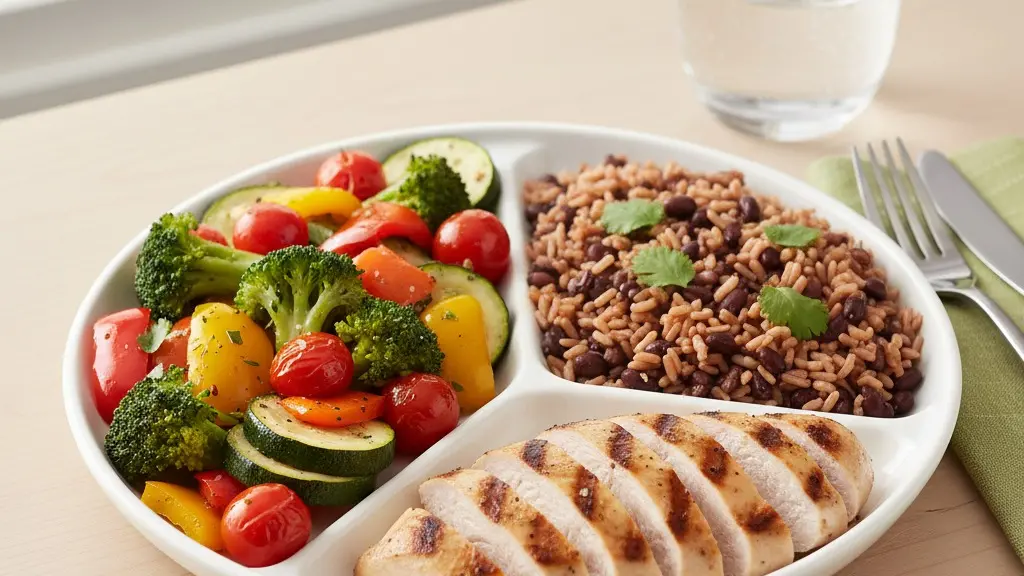
First, draw an imaginary line down the middle of your plate. Fill one entire half with non-starchy vegetables. This isn’t a garnish; it’s the foundation. Think vibrant broccoli, crisp salads, roasted asparagus, sautéed spinach. This half is your anchor of fiber, vitamins, and minerals—the micronutrient powerhouse that modern diets so often neglect.
Next, take the remaining empty half and divide it in two, creating two equal quarters. In one of those quarters, place your protein. This could be a piece of grilled chicken, a fillet of fish, a scoop of lentils, or a block of tofu. This is the structural building block for your body, essential for muscle repair, satiety, and metabolic function.
Finally, in the last quarter, add your complex carbohydrates or starches. This is where the quinoa, brown rice, sweet potato, or whole-wheat pasta goes. These aren’t the enemy; they are the slow-release fuel for your brain and body, the energy source that, when portioned correctly, prevents the insulin spikes and crashes that haunted Elena’s afternoons.
The first time Elena tried it, something shifted. She wasn’t dieting; she was composing. Her plate, once a monochrome landscape of pasta, transformed into a mosaic of color and texture. The sheer volume of vegetables was surprising at first, but she found herself feeling full and satisfied on a deeper level. The post-dinner slump that used to drag her to the couch was replaced by a gentle, sustained energy. Her creative mind, fueled properly, felt sharper.
The Plate Method is powerful because it sidesteps the anxiety of modern nutritional science. It doesn't demonize carbs or idolize protein. It doesn't demand you track every morsel. Instead, it uses a simple visual cue—the geography of your plate—to guide you toward balance without conscious effort. It works across cultures, adapting to a vibrant Indian thali as easily as a classic Mediterranean meal. The "vegetable half" could be ratatouille, saag paneer, or a Midwest succotash. The protein and carb quarters are just as versatile.
But its simplicity can also be its most misunderstood feature. In a world obsessed with bio-hacking, data, and optimization, can something this simple really be effective? We are conditioned to believe that meaningful change requires struggle, that health is something to be wrestled into submission through rigorous tracking and deprivation. The Plate Method whispers a different, more profound truth: that our bodies have an innate wisdom, and sometimes the best thing we can do is give them a balanced starting point and get out of the way.
It’s a gentle rebellion against dietary dogma. It suggests that wellness isn't a password-protected, premium-access feature of life. It’s an open-source principle available to anyone with a plate. It reclaims the meal from the clutches of the calculator and returns it to the realm of intuition and aesthetics. The goal is no longer a perfect number, but a pleasing picture. And in composing that picture, you almost accidentally compose a healthier self.
Perhaps the food maps of the past had it all wrong. Health isn't a territory to be conquered with complex charts and militant discipline. It's a landscape to be cultivated, one plate at a time. It’s a quiet, visual harmony that, once you see it, you can’t unsee—a simple circle that teaches you everything you need to know.