
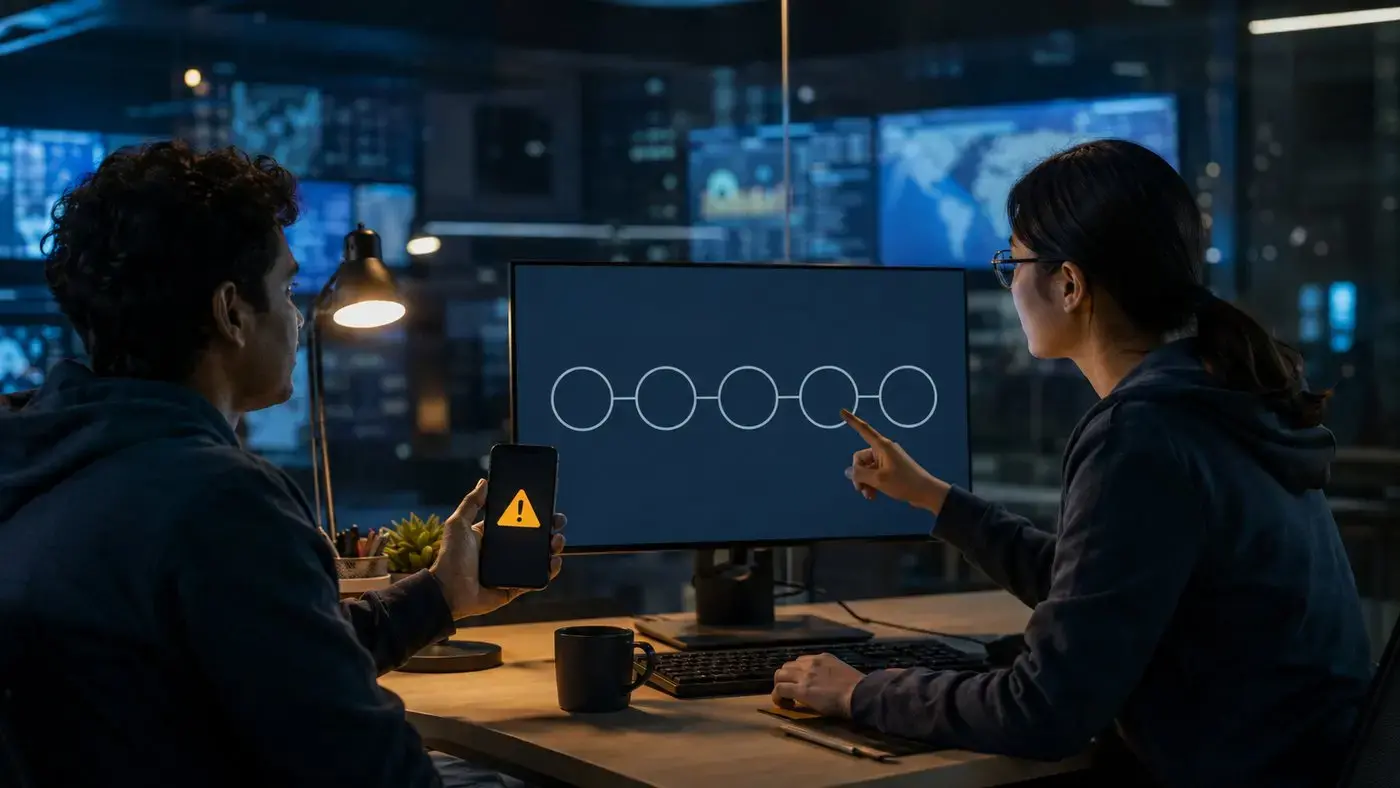
It is 3:14 AM on a Tuesday. The world is silent, save for the rhythmic hum of a refrigerator and the soft breath of a sleeping city. Then, the silence is shattered. Not by a scream, but by a sound more visceral to the modern engineer: the persistent, jarring trill of a PagerDuty alert.
In that instant, the human nervous system undergoes a violent transformation. Cortisol floods the bloodstream. The heart accelerates. The prefrontal cortex—the part of the brain responsible for logical reasoning—struggles to keep the reins as the amygdala screams "danger." This is the "digital emergency room," where the patient is a global network and the surgeons are weary developers staring at blue-light screens.
The transition from this state of primal panic to a state of clinical "flow" is not an accident of nature. It is a choreographed dance of technology and human psychology. Mastering incident response isn't just about fixing a bug; it’s about reclaiming the calm from the clutches of chaos.
The Anatomy of the Digital Storm
To understand why incident response often fails, we must look at the "Novelist’s Dilemma." Imagine a writer, let's call her Elena, who has spent years crafting a complex mystery. One night, a gust of wind blows her manuscript out the window, scattering five hundred pages across a dark, rainy street. If Elena runs out and grabs pages at random, she will likely lose the plot forever. To save her work, she needs a system: a flashlight, a sequence, and a way to categorize the damage.
In the world of uptime and microservices, our "manuscript" is the production environment. When things break, the instinct is to grab at random pages—to check logs, then jump to databases, then poke at deployments. But without a framework, we are just getting wet in the rain.
Here are the five steps to transforming that 3:00 AM panic into a masterclass in resolution.
1. Triage: The Art of Knowing What is Bleeding
When an alert fires, the first mistake is treating every beep like an explosion. True mastery begins with triage. Is this a "Category 5" hurricane or a leaky faucet?
PagerDuty’s power lies in its ability to aggregate and suppress noise. The first step is to ruthlessly categorize the incident. If the checkout button is broken on an e-commerce site, that is a cardiac arrest. If a font is rendering incorrectly in the footer, that is a hangnail. By defining severity levels (Sev-1 to Sev-5) before the crisis hits, you give your brain a rubric to follow when it is too tired to think.
2. The Pilot’s Checklist: Establish the Incident Commander
In aviation, there is a concept called "sterile cockpit" during emergencies. One person flies the plane; another handles the radio. No one talks about the weather.
In incident response, this role is the Incident Commander (IC). The IC does not touch the code. They do not look at the logs. Their sole job is to maintain the "big picture." They delegate tasks, track progress, and—most importantly—shield the "Subject Matter Experts" from the frantic questions of stakeholders. When a team has a clear leader, the collective blood pressure of the organization drops. The chaos is contained because someone is holding the map.
3. The Paper Trail: Communication as a Healing Tool
Chaos thrives in a vacuum. When an incident occurs, the silence from the engineering team can be more terrifying to a CEO than the outage itself.
Modern PagerDuty mastery involves "internal transparency." This means setting up automated status updates that bridge the gap between the dark room of the engineer and the bright boardroom of the executive. By providing a "heartbeat" of information—even if that information is simply "we are still investigating the database latency"—you prevent the secondary disaster of a dozen Slack messages asking "Is it fixed yet?"
4. The Investigation: Finding the "Why," Not the "Who"
The climax of any incident is the moment of discovery. This is where the tension peaks. It is easy to find a scapegoat: “Who pushed this code at 5:00 PM?” But a master of the craft knows that "who" is a dead end.
We must look for the systemic failure. Did the CI/CD pipeline fail to catch the error? Was the monitoring too slow? Using PagerDuty’s visibility tools, we look for patterns, not people. We treat the incident as a mystery novel where the culprit is always a process, never a person. This psychological safety allows engineers to speak freely, leading to faster resolutions.
5. The Post-Mortem: Turning Scars into Armor
The incident is over. The "Patient" is stable. The sun is coming up. The final, and most crucial, step is the blameless post-mortem.
A post-mortem is not a funeral; it is an autopsy for the sake of the living. We document every timeline, every decision, and every "near-miss." This data is fed back into PagerDuty to refine future alerts. Over time, the system becomes more intelligent, the alerts become more precise, and the 3:14 AM wake-up calls become fewer and farther between.
The Philosophical Horizon
We often view downtime as a failure of technology, but it is actually a fundamental characteristic of complex systems. As our digital worlds grow more intricate, "chaos" is not a bug; it is an environment.
Mastering PagerDuty is not about achieving a state where nothing ever breaks. That is an impossible dream. Instead, it is about developing the human resilience and the structural elegance to face the breakages with a level head. It is about the transition from the frantic "grab" for pages in the rain to the calm, systematic reconstruction of the story.
When the next alert sounds—and it will—you won't just see a crisis. You will see a process. And in that process, there is peace.
Make the Five Steps Repeatable
The process works best when the supporting details are prepared before an outage. Every service should have a named owner, a current escalation path, a short runbook, and links to the dashboards that show whether customers are affected. Test those materials during routine drills. A runbook that has not been opened for a year may contain obsolete commands, former employees, or dependencies that no longer exist.
Teams should also define a small vocabulary for incident severity and status. When “critical,” “degraded,” and “monitoring” mean the same thing to engineering, support, and leadership, updates become faster and less emotional. After recovery, turn the post-incident actions into owned work with deadlines. Otherwise the same alert will return, and the organization will have documented the lesson without applying it.
PagerDuty coordinates attention, but it cannot replace judgment. The goal is to give responders enough structure to think clearly under pressure while leaving room for technical expertise. Regular practice, accurate service ownership, and honest follow-through are what convert the five steps from a checklist into a dependable response system.