
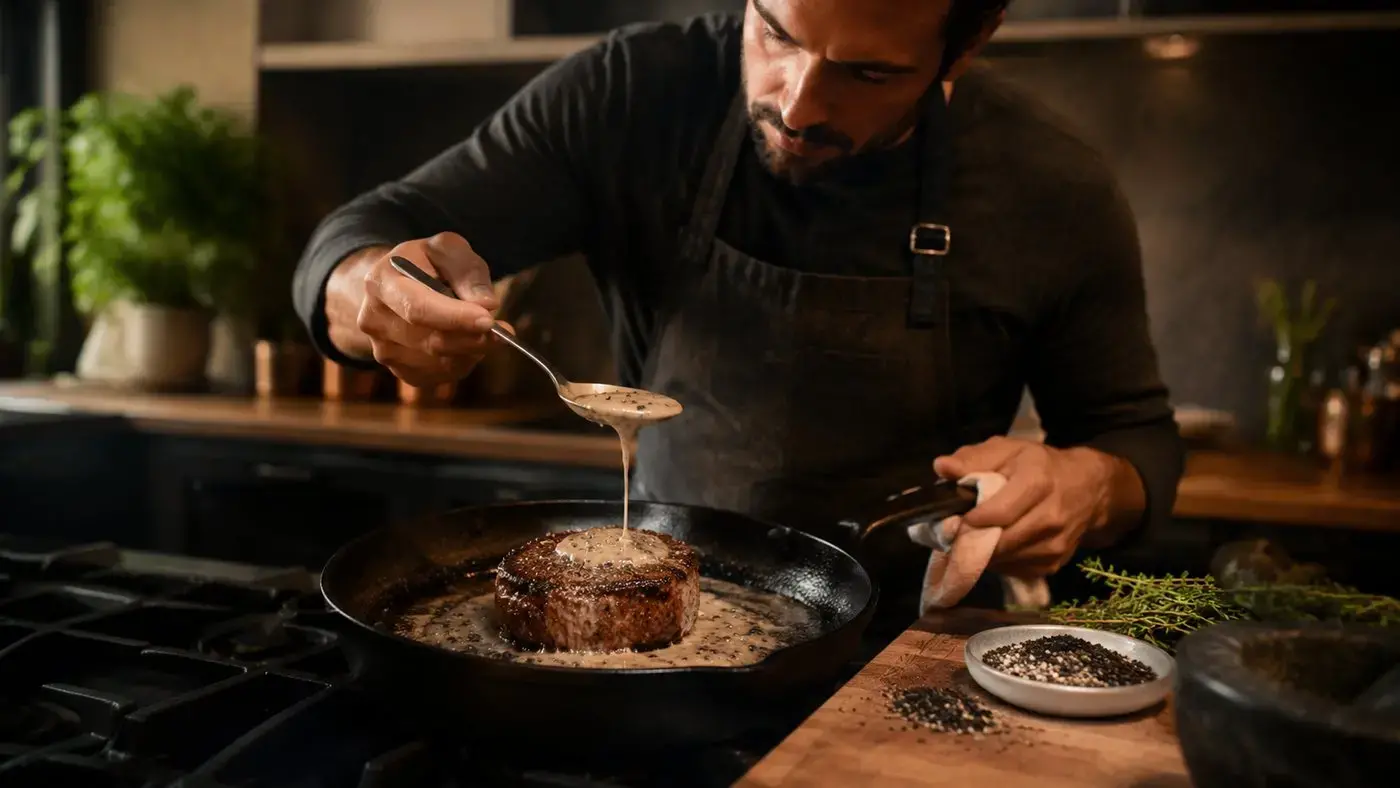
The French have a word for the sensory overload of a bustling bistro at twilight: effervescence. It is the clatter of silver against porcelain, the low hum of gossip, and, most importantly, the olfactory punch of searing beef and cracked peppercorns. For decades, we have been conditioned to believe that this particular alchemy—the creation of a world-class Steak au Poivre—is a ritual reserved for men in tall white toques and the high-priced reservations that follow them. We treat the dish as a mystery of state, a complex chemical equation that requires a professional deglazing station and a lifetime of apprenticeship.
But what if the white tablecloth is a lie? What if the most sophisticated meal in the Gallic canon is actually a study in brutalist simplicity, achievable in the time it takes to listen to a three-song set on the radio?
To understand the Steak au Poivre is to understand the physics of the "crust." Consider the case of Julian, a high-stakes architect who spent years trying to replicate the perfect steak he once had in Lyon. He bought expensive sous-vide machines and digital probes, yet his steaks always emerged gray, flaccid, and uninspired. He was focused on the internal temperature while ignoring the external transformation. The secret Julian eventually discovered wasn't in the technology, but in the friction.
The Architecture of the Crunch
At its core, Steak au Poivre is a marriage of heat and pressure. The "Poivre"—the pepper—is not a seasoning here; it is a structural component. Unlike a standard steak where salt disappears into the fibers, the peppercorns must be cracked coarsely, ideally under the flat of a heavy saucepan, creating a jagged landscape of spice. When pressed into the raw meat, these shards form a physical barrier, a rugged armor that protects the juices while inviting the Maillard reaction to go into overdrive.
As the steak hits a shimmering hot cast-iron pan, a violent transformation begins. The proteins and sugars on the surface of the meat reorganize themselves into hundreds of new flavor compounds. This isn't just "cooking"; it is an elemental change. The peppercorns toast in the rendered fat, losing their raw, nasal sting and evolving into something floral, woody, and deeply savory.
In a mere four minutes per side, you aren't just heating meat; you are building a monument to texture. The tension of the dish lies in this duality: a exterior that resists the knife with a satisfying crunch, yielding to an interior that is butter-soft and deceptively delicate.
The 15-Minute Narrative
The beauty of this dish is its narrative economy. There is no "slow and low" here. There is no marinating. It is a sprint. Once the steak is pulled from the pan to rest—a crucial five-minute intermission where the muscle fibers relax and reclaim their juices—the real magic happens in the "fond."
The fond is the collection of caramelized bits stuck to the bottom of the pan. To the untrained eye, it looks like burnt debris; to the cook, it is liquid gold. This is where the "15-minute" promise is fulfilled. A splash of cognac or brandy hits the hot metal, igniting a brief, controlled inferno that deglazes the pan, lifting those concentrated flavors into a silken sauce.
When you stir in a pour of heavy cream and a whisk of Dijon mustard, the sauce emulsifies almost instantly. It is a chemical bridge, connecting the spicy heat of the pepper to the richness of the beef. It is thick enough to coat the back of a spoon and decadent enough to make you forget you’re standing in your own kitchen in your socks.
The Philosophy of the Skillet
Why does it matter that we can do this at home, quickly? Because we live in an era of "convenience" that often strips us of our agency. We outsource our joy to delivery apps and pre-packaged kits, sacrificing the tactile thrill of creation for a few minutes of saved labor.
Reclaiming the Steak au Poivre is a small act of domestic rebellion. It proves that excellence does not require a sprawling brigade or an hour of preparation. It requires only three things: high-quality ingredients, a heavy pan, and the courage to let the heat do its work.
The complexity we often fear in French cooking is frequently a ghost—a phantom conjured by tradition to keep the gates closed. When you slice into that steak, the crust shattering under your blade, you realize that the bistro experience wasn't something you had to buy. It was a skill you already possessed, waiting for a little bit of pepper and a lot of heat.
As the steam clears and the sauce settles into a glossy pool on your plate, the "effervescence" of the restaurant begins to fade. In its place is a quiet, profound satisfaction. You haven't just made dinner; you've mastered a classic. And you still have the rest of the evening ahead of you.
Timing the Steak and Sauce
Bring the steak toward room temperature only briefly, then dry every surface well. Season with salt and press coarsely cracked pepper into both sides. Fine pepper burns more easily and cannot create the characteristic crust. Heat a heavy skillet until the oil shimmers, place the steak away from you, and leave it undisturbed long enough to brown. Turn once, adjust the heat if the pepper threatens to scorch, and use an instant-read thermometer if you are unsure of doneness.
Move the steak to a warm plate and let it rest while you make the sauce. Pour off excessive fat but keep the browned fond. Remove the pan from an open flame before adding cognac or brandy, then return it to controlled heat and scrape the bottom. Add cream and Dijon, simmer until the sauce coats a spoon, and taste before salting. Resting juices from the steak can be stirred into the sauce at the end.
Serve immediately after slicing across the grain. The sauce should support the pepper crust rather than drown it, so spoon a small amount underneath or alongside the meat. A simple salad, green beans, or crisp potatoes provide contrast. With the ingredients measured and the pan properly heated, the fifteen-minute promise becomes realistic: the steak rests during the only sauce work, and the same skillet carries flavor from sear to finished plate.